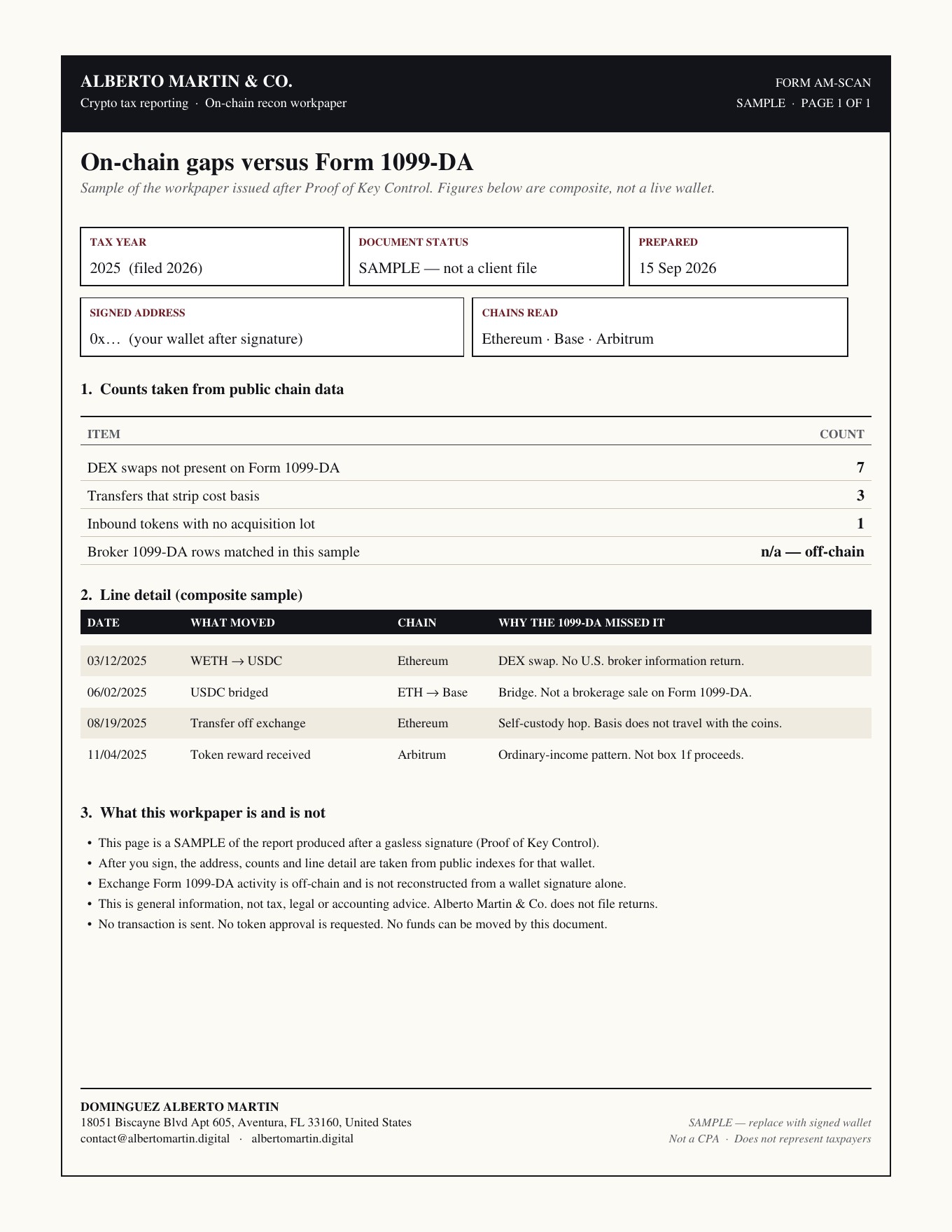
Form 1099-DA · Tax year 2025 filed in 2026
Your 1099-DA is almost certainly not your tax bill
The exchange sent IRS the turnover. Tax is profit. DEX swaps, wraps and wallet hops never hit that form. Connect the wallet — we read the public chain and show what the 1099 missed.
- Brokers sent IRS gross proceeds
- Proceeds ≠ gain
- Swaps on-chain are invisible to the 1099-DA
“$186,400 on the 1099-DA. $11,200 of actual gain after basis. The form was not wrong. It was incomplete.”
The IRS already got a copy. The only question is whether your return matches.
Dual delivery, automated matching, and why copying the form is the expensive shortcut.
A 1099-DA is issued twice. Copy B reaches you by mail or in the exchange’s tax center. Copy A goes to the IRS under your taxpayer ID. For sales in 2025, brokers had to report gross proceeds. Reporting basis was voluntary, so a large share of 2025 forms show a proceeds figure with basis blank or marked as not reported to the IRS.
The IRS matches those information returns against the Form 8949 and Schedule D you file. When the numbers do not line up, the usual first contact is not an audit. It is a CP2000 notice: a computer-generated proposal that adds the income it thinks is missing, calculates tax on it, and often adds a 20% accuracy-related penalty plus interest.
Why “I’ll just copy the form” makes it worse
If basis is blank and you copy the form, you have two bad paths. Enter the proceeds with no basis and you pay tax on turnover. Leave the sales off because the numbers look wrong and the IRS sees unreported proceeds; the proposal can tax the full amount as if you paid nothing. Either way, the burden to show what you paid sits with you.
| What you file | What matching sees | Likely result |
|---|---|---|
| Proceeds $186,400, basis $0 | Matches the 1099-DA | Tax on $186,400. You overpay on $175,200 of basis. |
| Crypto sales left off | $186,400 of unreported proceeds | Notice proposing tax on the full amount, plus penalty and interest. |
| Proceeds $186,400, documented basis $175,200 | Proceeds match, basis supported | Tax on $11,200 of gain. |
The rule on Form 8949 is simple: report proceeds exactly as the form shows them, and put the basis you can document next to them. See where your basis broke
Three places cost basis disappears.
None of these are exotic. They are what ordinary crypto activity looks like on paper.
Transfers between your own wallets
Moving coins from an exchange to a hardware wallet and on to another exchange is not a sale. But each hop strips the record. The last exchange receives units with no purchase date and no cost, sells them for you, and reports the proceeds with basis blank.
Assets that arrive with no history
Coins from a platform that closed, an early token sale, mining, a DeFi position you exited, or a friend who paid you back in crypto. The receiving broker cannot know what they cost. Unless you can show it, the working assumption becomes zero.
Fees, wraps and swaps booked as new lots
Gas paid in ETH is a small disposal of ETH. Wrapping ETH, bridging a stablecoin or swapping one token for another can be recorded by software as a sale plus a brand-new purchase. Done wrong, lots split, holding periods reset, and long-term gains turn short-term.
Staking, swaps, and transfers between wallets — this is where the report breaks.
How the rules generally apply. Your facts decide the rest.
Swaps are disposals
Trading token A for token B is a sale of A at its fair market value at that moment. It does not matter that no dollars touched your bank. Swaps on a DEX generally do not appear on any 1099-DA, which is exactly why they drop off returns built from the form.
Staking rewards are income when received
The IRS position in Revenue Ruling 2023-14 is that staking rewards are ordinary income at fair market value when you gain control over them. That value also becomes the basis of those units. Miss the income and you usually miss the basis too, so the same coins get taxed in full when sold.
Transfers are record breaks, not automatically tax
Moving your own coins between your own wallets is not a taxable event. The problem is documentary: the trail that proves basis ends at the sending address unless both legs are matched in your records.
Under IRS transitional relief, brokers are not currently required to report wrapping, staking, lending or liquidity-provider transactions on the 1099-DA. Not reported does not mean not taxable.
Same wallet. Three programs. Three different tax bills.
Same 40 transactions imported three times. The difference is classification, not arithmetic.
| How each tool read it | Tool A | Tool B | Tool C |
|---|---|---|---|
| 9 transfers between own wallets | Matched, basis carried over | Read as new deposits at $0 cost | Matched, basis carried over |
| 3 wraps / unwraps | Not treated as sales | Not treated as sales | Each treated as a sale plus a new lot |
| Lot selection | Per wallet, specific lots | Per wallet, first in first out | One pool across all wallets |
| 4 staking receipts | Income at value when received | Income at value when received | Imported as $0-cost deposits, no income |
| Proceeds counted | $58,900 | $58,900 | $66,100 |
| Capital gain | $6,380 | $21,950 | $9,330 |
| Ordinary income, staking | $2,140 | $2,140 | $0 |
| Total taxable amount | $8,520 | $24,090 | $9,330 |
Tool B’s total is inflated because it never paired the transfers, so coins you already owned look like free money. Tool C looks almost as cheap as Tool A and is still unusable: it skipped income, and since January 1, 2025 basis is tracked wallet by wallet, not in a single pool.
The lowest total is not automatically the right one. The right one is the total whose classification you can explain line by line. No software recommendations here, and no affiliate links.
Prior years are visible too.
2025 is the first 1099-DA year. The coins sold in it were bought earlier.
Unfiled or sloppy 2022–2024 crypto still matters. Every Form 1040 in those years asked a yes-or-no digital asset question. Exchanges kept records long before 1099-DA existed, and the IRS has used John Doe summonses to obtain customer records from exchanges before.
The 1099-DA era makes the gap more visible going forward. A 2025 sale of coins bought in 2022 raises a simple question: where did the purchase show up, and did the earlier sales and swaps show up at all? Transfer-in data on the new forms points straight at wallets that existed before.
The normal window for the IRS to assess tax is three years from filing. It stretches to six years if more than 25% of gross income was left off, and there is no limit when no return was filed.
Register with your wallet. Unlock the mismatch list.
One signature. That is the account. The recon pack opens after you sign.
- Your reporting risk profileLow, Medium or High, with the four specific holes most likely to break your return.
- 1099-DA vs your actual gainLine by line: what each box on the form means and what you reconcile against it.
- Recon templatesExchange, wallet, transfer, missing basis and staking sheets, with sample rows.
- Weekend close-outThe order of operations, Saturday morning to Sunday afternoon.
Prove the wallet. See the missing swaps.
Proof of Key Control
Tax reporting relies on definitive ownership of addresses. Before we map your risk profile against common 1099-DA mismatches, we verify key control via a gasless signature.
What this does: Opens a read-only scan of public chain data for this address.
No injected wallet detected.